





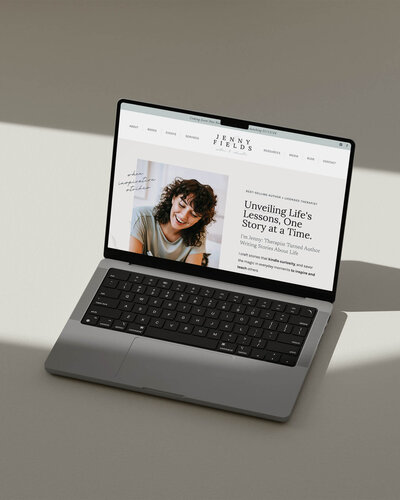






I’ve audited a lot of websites over the years + the same pattern comes up time + time again. You’ve put a ton of real time + money into your site… but visitors are landing on your homepage + leaving almost immediately. Not because your offerings are bad… But because your homepage isn’t giving them a reason to stay.
That’s what bounce rate measures… and if yours is higher than you’d like, this post is going to walk you through exactly why that’s happening + what to do about it.
What is a bounce rate?
A bounce is simply when one of your website visitors only visits a single page on your site and didn’t click through to any other pages. (So a bounce rate, is the percent of visitors that bounce on your website.)
WHY BOUNCE RATES MATTER
Bounce rate is calculated based on the ratio of all visitor sessions to those that only had a single-page visit. While there are a few exceptions, a high bounce-rate typically indicates that visitors aren’t finding what they are looking for because they are only visiting one page on your site.
A low bounce rate is a good sign that visitors are engaged and actually interested in what you’re offering. While it’s nearly impossible to have a 0% bounce (or even a single-digit bounce rate), there are some realistic ranges and averages you can aim for shown in the table below. (Data sourced from Semrush/Databox, 2024)
| Type of Site | Average Bounce Rate |
|---|---|
| Service-based Websites | 30-50% |
| Retail-based Websites | 20-40% |
| Blogs / Informational Websites | 40-60% |
| Landing Pages | 70-90% |
Because your homepage is likely your most visited page, ensuring you have a good bounce rate on that page specifically is super important!
How to Check Your Website Bounce Rate
Once your site is designed, developed and launched you can use a popular analytics software such as Google Analytics to keep track of your bounce rate, but before you launch your site you should implement a homepage design that aims for engagement and a low bounce rate if keeping people on your site is part of your website goals.
- Log into Google Analytics and make sure you’re in a GA4 property.
- In the left sidebar, click Reports Go to Engagement → Pages and screens
- You won’t see “bounce rate” by default. (GA4 hides it.)
- To add it, click the pencil icon (top right) to customize the report Under Metrics, search for “bounce rate” and add it
- Click Apply and Save (save as a new report so you don’t lose it) You can now see bounce rate per page, sort by your homepage URL to find your number
And don’t forget to check how your homepage looks and functions specifically on MOBILE.
Globally, mobile devices now account for over 62% of all web traffic (StatCounter, 2024)… and even in the US, mobile has overtaken desktop. If your homepage isn’t optimized for a small screen, you’re losing visitors before they ever read a word.
Here’s how to check the bounce rate on your mobile site specifically:
- Go to Reports → Engagement → Pages and screens
- Find your homepage in the list.
- At the top of the report, click Add comparison (the + icon near the top left of the report)
- In the dimension dropdown select Device category
- Add three comparisons: desktop, mobile, and tablet
- Click Apply. Your report will now show columns split by device so you can see bounce rate for each side by side
Quick note if you’re using GA4: bounce rate is now calculated differently than it was in Universal Analytics. In GA4, an ‘engaged session’ is one that lasts longer than 10 seconds, so your numbers may look very different than they used to.
Your homepage design is making an impression whether you like it or not
Here’s something I’ve seen play out dozens of times working with clients: a website can have incredible copy, a strong offer, and real expertise behind it, and STILL lose visitors in the first five seconds because the design feels off.
Not broken or ugly necessarily, just… off. Cluttered, inconsistent, hard to read. And that split-second impression is often all you get.
When I’m looking at a homepage, these are the four design elements I look at first:
- White Space – Is the page breathing, or does it feel like everything is competing for attention at once? A cramped page makes people feel overwhelmed
- Harmony – Do the colors, fonts + images feel like they belong together? Inconsistency sends sneaky signals to visitors that the business behind the site isn’t quite put together either.
- Balance – Is there a natural rhythm between text + visuals? A page that’s ALL text is exhausting. A page that’s ALL images says nothing.
- Readability – Are you using headers + subheadings to break up your content? Most visitors scan before they read. If your page doesn’t reward scanning… most people won’t stick around long enough to actually read it.
(Pssttt… the same principles that make a homepage convert apply to your sales page.)
Nobody cares about your business… here’s what to do about it.
Your visitors don’t actually care about your business. (I know, ouch.) But what they DO care about is what your business can do for them. The second your homepage starts talking more about you than it does about them… you’ve lost them.
When I’m writing or reviewing homepage copy, here’s what I’m always checking:
- Positioning – Do you tell your visitors immediately who you are, what you do and who you do it for? If you aren’t letting them know they’re in the right place right of the bat, they’re going to bounce. This one is huge and most people aren’t doing it correctly.
- Jargon – Are you using industry language that only YOU understand? If a stranger landed on your page + had no context for what you do… would they get it? If the answer is… maybe, then simplify it.
- Tone – Does it sound like a real human wrote it, or does it sound like a corporate brochure from 2009? Your copy should feel like a conversation, not a press release. Branded, warm + REAL.
- Social proof – Are you letting your past clients do some of the selling for you? Testimonials with real photos + real names will do more for your conversion rate than almost anything else on this list. Don’t skip this.
Related Post: How to Focus Your Marketing Messages to Reach Your Audience
If your website is annoying people, they will leave (it’s as simple as that…)
User experience is one of those terms that gets thrown around a lot… but in its most basic form it just means this: what is it actually LIKE to be a visitor on your website?
Is it easy, intuitive and enjoyable? Or is it confusing, slow and frustrating? Because the latter will send people running every single time.
Here’s what I look at when I’m evaluating UX on a homepage:
- Page speed – This one is non-negotiable. If your page takes more than a few seconds to load, a huge chunk of your visitors are already gone before they’ve seen a single thing. Run your site through Google PageSpeed Insights + see where you stand.
- CTAs – Yes, you need them, but more is NOT more here. Too many buttons, pop-ups + options creates decision fatigue. Pick ONE primary action you want your visitor to take + make that the focus.
- Auto-play – Please, I am begging you… do not auto-play video or audio on your homepage. Nothing makes someone close a tab faster. NOTHING.
- Navigation – Is there a clear, logical path from your homepage to the next step? Your visitor should never have to think too hard about where to go next. Make it obvious.
- External links – If you’re linking out to other sites, make sure they open in a new tab. Every link that pulls someone away from your page is a potential exit you didn’t plan for.
Related Post: 5 Website Design Errors to Avoid Before Launch
Key Takeaways on Your Homepage Bounce Rate
Here’s the bottom line… a high bounce rate isn’t just a vanity metric to stress about… it’s a signal.
It’s your website telling you that something isn’t connecting. The design feels off, the messaging isn’t landing, or the experience is frustrating people into leaving.
The good news is that every. single. thing. on this list is fixable. You don’t need to blow up your entire website + start over. Sometimes there’s just one section of copy that needs tightening or part of your mobile design that needs attention.
Start by pulling up your homepage right now + asking yourself honestly: If I landed here for the first time + knew nothing about my business… would I stay? Would I know exactly what to do next?
If the answer is anything other than YES… it’s time to make some changes. + if you’d rather hand that job off to someone who does this every single day, that’s exactly what my VIP Day is for.