
















If you’ve ever sat down to write a blog post and thought, “Okay… but what keywords am I supposed to be using?”… you’re in good company.
I used to second-guess every single post I wrote. Was I choosing the right keywords? Were they too competitive? Not competitive enough? Was I accidentally sabotaging my own SEO without realizing it?
After more than 15 years of blogging, redesigning websites, and watching what actually moves the needle, I can tell you this:
Choosing keywords doesn’t need to be complicated… but it does need to be intentional.
In this post, I’m breaking down:
- how to choose keywords in a way that makes sense for real humans
- keyword search techniques that actually work today
- where to place keywords for SEO (without sounding robotic)
- and how tools like Yoast focus keyword fit into the bigger picture
Related Post: SEO Mistakes: 5 Reasons Your Website Isn’t Showing Up on Google
What Is the Meaning of Keyword Search?
Before we get tactical, let’s agree on what I really mean I say keyword research.
Keyword search simply means identifying the exact words and phrases people type into Google when they’re looking for something.
Not what you would call it. Not what sounds clever. Not what your industry uses internally. What people are actually searching.
When you understand the meaning of keyword search this way, SEO stops feeling like a guessing game and starts feeling more like just listening to your customers and clients.
How I Actually Choose Keywords (3 Approaches That Work)
There isn’t one “right” way to choose keywords. Depending on how you create content and your writing style, one of these will usually feel more natural than the others, and that’s perfectly ok.
Strategy #1: Choose Keywords First (Data-Led Content)
The first strategy is to find the right keywords BEFORE you start writing your blog post (or page).
This is my go-to approach when:
- I want traffic potential baked in from the start
- I don’t know what to write about
To start, you need to look for high volume keywords that have a low competition score within your industry. Here’s how I do it:
- I start with a broad topic (SEO, blogging, web design, etc.)
- I use keyword research tools like Ahrefs or SEMrush or Keywords Everywhere
- I look for keywords with:
- 100–1,000+ monthly searches
- low to moderate competition
- clear intent (not vague curiosity)
Related Post: 5 Things I Did to Increase Organic Traffic 10x
This is where strong keyword search techniques matter. I’m not just looking at volume… I’m looking at who is ranking and why.
If Google is already ranking detailed, helpful content, that’s usually a green flag.
Check the top three ranking websites and look not only at the main content of the posts, but their length, how they are written, the images or visual aids used and the wording of the headings that break them up. This will give you a clue on what elements you should be including in your own post.

Also, pay attention to the DR (domain rating) of the top 10 results.
Are they anywhere close to your own domain rating? (If you don’t know you can check your domain rating here.) If the site ranking for a term is not even in the same ballpark as you, you might need to pick a less competitive keyword. Try the “Related Terms” tab in your keyword tool to find similar terms that you might be able to relate for better.
Strategy #2: Write First, Optimize Second (Voice-First Content)
The second strategy is to write your blog post first and then find keywords that fit the topic afterward. Sometimes I already know what I want to say, especially if it’s something I explain to clients over and over again.
When that happens, I…
- Start writing the post in my own voice (or use ChatGpt to write a blog draft)
- Identify the main themes after the first draft
- Research keywords that match what I already wrote
- Choose:
- one focus key phrase
- a few supporting variations
This approach keeps your writing human while still letting SEO do its job.
A quick tip here: When optimizing, I often replace vague words like this, thing, or stuff with clearer language that happens to include a keyword, without forcing it.
Strategy #3: Use Google’s “People Also Ask” (and Reddit)
This is one of the most underrated keyword strategies.
When you search something in Google, the “People also ask” section shows you:
- what Google already understands as related intent
- what people are confused about
- what follow-up questions they have
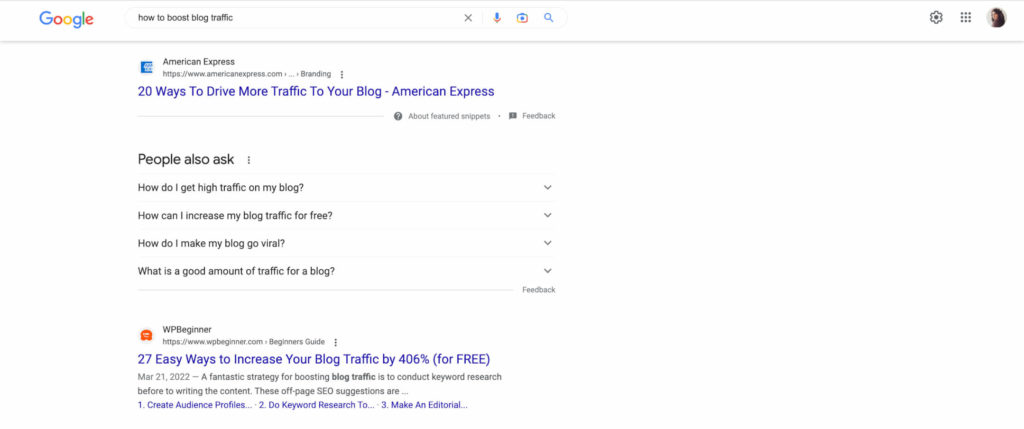
I’ll often use those questions as subheadings or build entire sections around them. It’s kinda genius. People are already asking these questions. You just have to answer them!
For example, if I’m writing a blog post about “custom web design,” I can enter this keyword into Google search and look for related questions that people are asking, such as “What is a custom web design?“, “Is a custom website worth it?“, and “How do I create my own web design?“
Then I’ll take it one step further and check Reddit, forums, or comments to see:
- how people phrase their questions
- what they’re frustrated by
- what answers feel incomplete elsewhere
This is pure gold for Google + generative search results because you’re answering real human questions …not just targeting keywords.
Where to Place Keywords for SEO (Without Ruining Your Copy)
This is where a lot of people overthink things when it comes to keywords and SEO. Here’s what actually matters for keyword placement + optimizing your on-page content:
- Page title (SEO title)
- H1 heading
- First 100–150 words
- Subheadings (only when it makes sense)
- Meta description
- URL (or slug)
- Image file names + alt text
- Internal links (use descriptive anchor text, not “click here”)
That’s it. You don’t need to hit some magic number or stuff your focus key phrase into every sentence. Google is much smarter than that now, thankfully 🙂
Common Keyword Research Questions
A few other questions that clients have asked me about SEO + keyword research…
Yes… as long as they share the same intent! Choose one primary keyword and support it with natural variations.
Not necessarily. Mid-volume, lower-competition keywords can often convert better and rank faster.
Sometimes days. Sometimes weeks. Sometimes months. SEO is a long game… but the payoff compounds.
Start with your domain rating.
How the Yoast Focus Keyword Fits In (and Where It Falls Short)
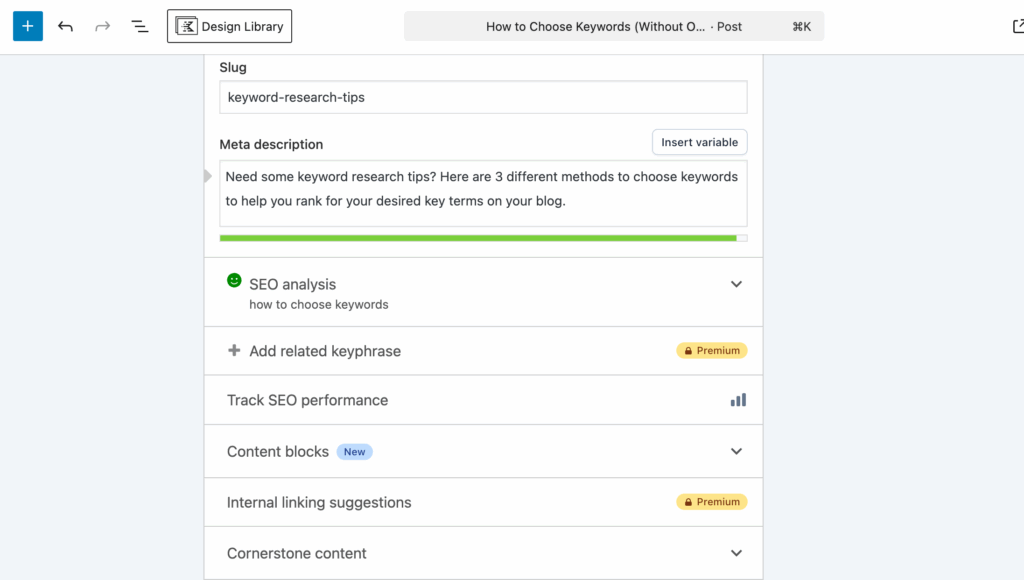
If you use the Yoast plugin for WordPress, the Yoast focus keyword feature can be helpful, but it shouldn’t be your north star.
I treat it like a checklist, not a rulebook. If the Yoast post color-indicator is red but your post is helpful, the intent is clear and the writing sounds like a human… I wouldn’t lose sleep over trying to make it “green”. SEO tools are assistants, not editors.
Watch the Video on Youtube: How to Use Yoast for SEO on Your WordPress Website
The Real Secret to Choosing Keywords That Work
Choosing keywords doesn’t have to feel technical, rigid, or like it’s sucking the life out of your brand voice. At its core, SEO is really about clarity… understanding what your audience is searching for and meeting them there with content that actually helps.
Over the years, I’ve learned that the best keyword strategy is the one you’ll actually stick with. Sometimes that means letting the data guide the topic. Other times it means writing from experience first and optimizing later. Both approaches work when the intent is clear and the content is thoughtful.
What matters most isn’t hitting a perfect keyword score or pleasing a plugin or SEO tool it’s creating content that answers real questions in a way that feels human, trustworthy, and aligned with your expertise. When you do that consistently, improved search rankings tend to follow.
If SEO has felt overwhelming in the past, take this as permission to simplify. Focus on choosing keywords with intention, placing them naturally, and writing like you’re talking to a real person on the other side of the screen. That’s how you build content that not only ranks, but lasts.
If you need help with choosing the right keywords on your website or ranking your content to drive more traffic and conversions to site, book a website audit here.